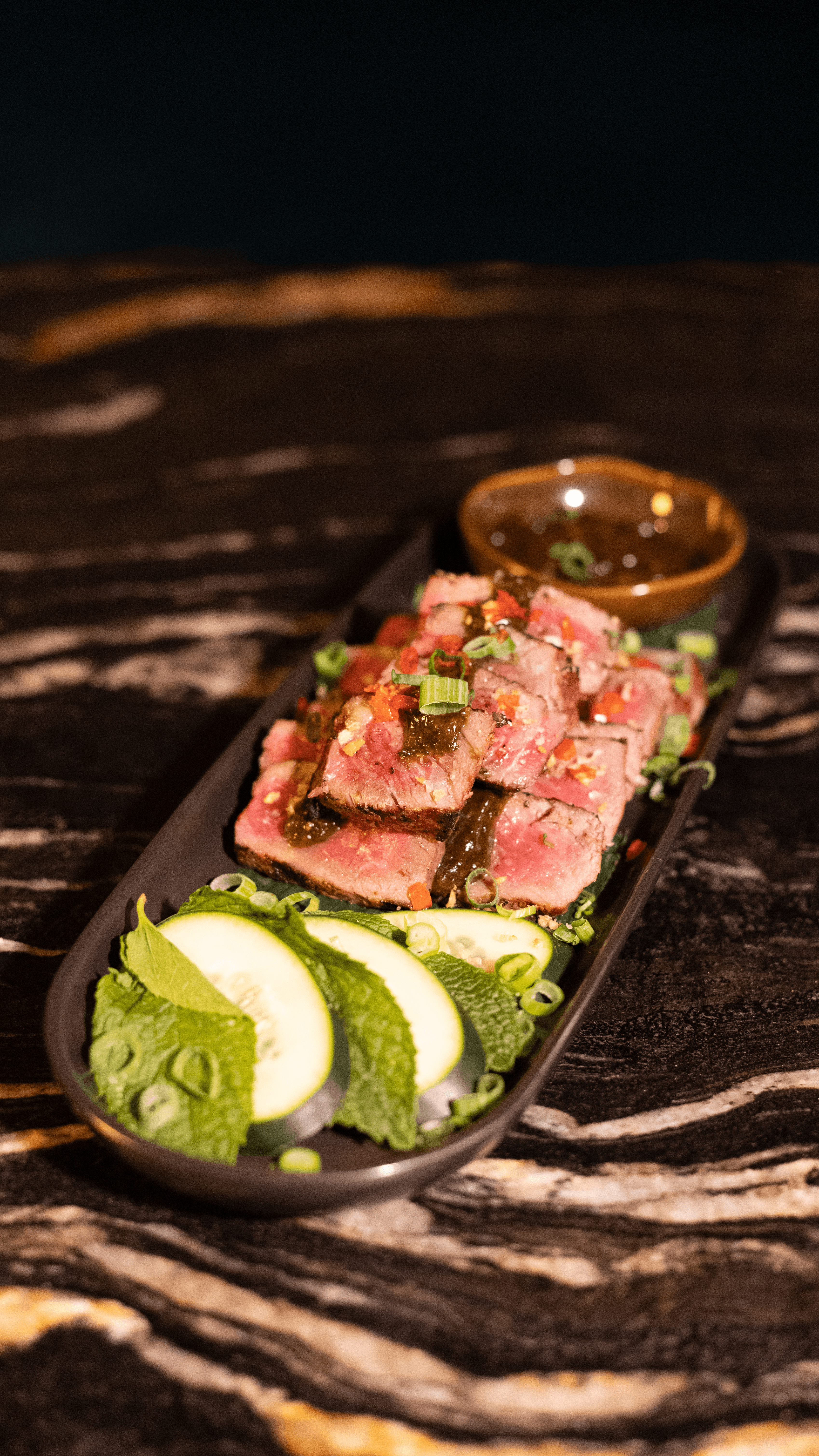

Crying Tiger Steak at Callisto — A Northern Thai Classic in Downtown Bentonville
There are a handful of dishes on Callisto's menu that may require some explanation before you order, and the Crying Tiger Steak is one of them. The name alone tends to generate questions at the table. The dish that follows answers most of them with the first bite: char-grilled ribeye, finished with nam jim jaew, scallions, pickled Fresno chili, and fried garlic — a Northern Thai preparation that has been making people eat steak differently for a very long time.
Here's what you need to know before you order.
What Is Crying Tiger Steak and Where Does the Name Come From?
Crying Tiger Beef, known in Thai as Suea Rong Hai, is a dish from the Isaan region of Northeastern Thailand — traditionally prepared with brisket, though most restaurants now use more tender cuts like ribeye or strip loin. The preparation is straightforward: marinated beef, grilled hard over high heat for char and smoke, sliced thin, and served with nam jim jaew — a dipping sauce that supplies what the beef itself doesn't.
The name comes with competing folklore, and no one typically agrees on which version is truly correct. One legend holds that the nam jim jaew dipping sauce is so spicy that even the most ferocious tigers cry when tasting it. Another story claims it was the meat being so tough that it made tigers cry from chewing it. A third version suggests the marbling on the steaks used in Thailand resembles tiger stripes, and when cooked, the fat drips like tears. The dish's actual Thai name, Suea Rong Hai, translates directly to "tiger crying" — a catchy name that leads to interesting conversations, with no confirmed origin story.
Originating in Northeast Thailand's Isaan region, it's popular to have as a beer snack — a tradition that translates naturally to a cocktail bar setting. At Callisto, a bar built around rum, tiki culture, and deliberate atmosphere, the Crying Tiger Steak fits not as a novelty but as a dish with genuine culinary lineage that earns its place on the menu.
What Is Nam Jim Jaew and Why Does It Matter?
The sauce is the centerpiece of the dish — not the steak, which is saying something given Callisto uses ribeye.
Nam jim jaew originated in the Isaan region of Northeast Thailand, where "jeaw" refers to a dipping sauce in the local dialect. "Nam jim" is a broader Thai term for various dipping sauces — so nam jim jaew essentially means "the dipping sauce from the Northeast." The sauce blends fish sauce, lime juice or tamarind, palm sugar, chili flakes, toasted rice powder, and fresh herbs like shallots — delivering a combination of spicy, sour, sweet, and savory with a distinct smokiness and crunch from the toasted rice.
That toasted rice powder is worth understanding separately. Glutinous rice, toasted until golden brown, gives the nam jim jaew a nutty flavor similar to rice crackers, adding crunchy texture alongside its flavor contribution. It's an ingredient that most guests can't identify on the first taste but would notice immediately if it weren't there — a textural and aromatic element that distinguishes an authentic nam jim jaew from a sauce that only approximates the flavor profile.
The full sauce is a parade of textures and tastes: nutty bits of crunchy toasted rice, umami-rich fish sauce, tangy lime juice, fruity tamarind, and fiery chili flakes working simultaneously. Against charred ribeye, it provides the acidity and brightness that rich, fatty beef always needs but rarely gets in a Western preparation.
Why Ribeye Specifically?
Ribeye is the preferred cut for crying tiger because it offers a great combination of fat and meat — the fat creates flare-ups on the grill, giving excellent char and smoke opportunities that leaner cuts simply can't produce. The marbling renders during the hard sear, basting the meat from the inside while the exterior develops the crust that gives the dish its defining textural contrast.
The char on a properly cooked ribeye does something that defines the whole dish. High heat applied directly to well-marbled beef creates a Maillard reaction — the browning process that generates hundreds of distinct flavor compounds simultaneously. The combination of succulent grilled beef with the spicy Thai dipping sauce creates an addicting combination precisely because the smokiness of the char and the sour, spicy depth of the nam jim jaew are designed for each other. Fatty, smoky, rich beef needs acid and heat as counterweight. The sauce provides both.
How Spicy Is the Crying Tiger Steak at Callisto?
Genuinely spicy, in a way worth knowing before you order. The nam jim jaew carries real chili heat — the chili flakes are one of the integral components of the sauce, and the heat level can be adjusted but not eliminated without changing the character of the dish entirely.
The pickled Fresno chili on the plate adds a second, brighter heat register — Fresno peppers are moderately hot and bring freshness that cuts through richness, with pickling tempering the sharpest edges while preserving the chili's character. Fried garlic and scallions provide aromatic support and freshness that moderate the cumulative heat somewhat.
For guests with low heat tolerance, this is the plate on the Callisto menu worth a conversation with your server before ordering. For everyone else — including guests who enjoy Thai food's characteristic balance of heat, acid, and savory depth — the spice level is what makes the dish worth ordering. The nam jim jaew is the reason people return to this plate, and its heat is inseparable from what makes it work.
Is Crying Tiger Steak a Good Sharing Plate?
It's one of the more natural sharing plates on the menu. Crying tiger is served sliced rather than whole — the steak is sliced thinly against the grain after resting, which means it arrives portioned and ready to pass around without anyone having to negotiate who cuts what. The sauce sits alongside rather than coating the beef, so each person at the table can control their ratio of steak to nam jim jaew, which is practical for tables with varying heat tolerance.
For a two-person table, the Crying Tiger Steak as a central plate — possibly alongside the Yellowfin Tuna Poke for contrast or the Hurricane Popcorn to open — covers the full range of what Callisto's food program is doing: something light and raw, something warm and snackable, something bold and substantial.
For groups, the sliced format scales naturally. It's the kind of plate that disappears across a larger table without anyone feeling like portions were uneven.
What Should I Drink with Crying Tiger Steak at Callisto?
The nam jim jaew gives you the most useful pairing signal: its combination of sour tamarind, tangy lime, fish sauce umami, and chili heat calls for a cocktail with enough brightness and acidity to hold its own alongside the sauce rather than getting flattened by it.
Callisto's tiki program, built on rum and fresh citrus, works naturally here. A rum cocktail with fresh lime and pineapple will cut through the ribeye's fat and complement the nam jim jaew's acidity without competing with the sauce's complexity. Something with passionfruit or a house-made tamarind-adjacent syrup — if Callisto's bar is running one — will echo the fruity sourness in the sauce itself.
Avoid anything sweet and dessert-forward. The nam jim jaew is doing too much interesting work to bury it under a rich, sugary cocktail. The drink's job here is to refresh the palate between bites and let the sauce stay in focus. Ask your server what's currently on the menu that fits — this is a bar that thinks about these interactions, and the recommendation will be worth following.
When Should I Order the Crying Tiger Steak During the Night?
Mid-evening is the natural timing. The steak is the most substantial plate on Callisto's menu — more filling than anything else in the lineup — which means it works best once the table has settled, drinks are flowing, and the evening has found its rhythm.
As an opening plate, it's a lot to arrive with, though for a table that came hungry and is planning a long night, it can anchor the whole spread from the start. Earlier in the evening, when the palate is fresh, the full complexity of the nam jim jaew is easier to appreciate.
Later in the night, as spirit-forward cocktails have stacked up, the ribeye's fat and protein provide genuine ballast. The bold flavors of the sauce hold up against heavier drinks in a way that more delicate plates don't. If the table is still going at midnight and wants something to carry the rest of the evening, this is the order.
How Does the Crying Tiger Steak Compare to Other Plates on the Callisto Menu?
Within Callisto's food program, the Crying Tiger Steak is the singular departure from the bar snack format. Everything else — the Hurricane Popcorn, the Shishito Peppers, the Mochiko Chicken, the Croquettes — exists comfortably in the shareable bar food register. The steak occupies different territory: more substantial, more demanding of attention, built on a culinary tradition that rewards people who understand what they're eating.
That's not a criticism of the other plates, several of which are excellent. It's a distinction that helps with ordering strategy. The Crying Tiger Steak works best when the table treats it as an event rather than one item among many — ordered with a drink in hand, eaten slowly, given the attention the nam jim jaew earns.
Executive Chef Alex Siharath's decision to include a Northern Thai preparation on a menu otherwise built around Hawaiian, Japanese, and Pacific-rim influences reflects the broader logic of Callisto's identity: a bar that draws from coastal and island traditions without limiting itself to a single geographic frame. Crying tiger belongs in that context the same way it belongs in the Isaan street food tradition it comes from — as something worth traveling for.
Is Callisto a Good Option for a Steak Dinner in Bentonville?
In the strict sense of a traditional steakhouse dinner, Callisto's Crying Tiger is operating in a different category. This is steak as Thai bar food — sliced, sauced, meant to be shared and eaten alongside cocktails. It's not a 16-ounce dry-aged cut arriving with sides. For that version of a steak dinner, other Bentonville restaurants serve that format better.
For a dinner experience built around exceptional drinks, bold flavors, and food that makes the cocktail program more interesting, Callisto is among the strongest options in Northwest Arkansas. The Crying Tiger Steak is the dish that distinguishes the menu from every other bar food program in the region — there's nothing else quite like nam jim jaew-finished ribeye within reasonable distance of the Bentonville square.
Owners Braxton and Izaak Barrett built Callisto around the idea of a tropical speakeasy with genuine craft behind every element. The hidden entrance through Midnight Gallery at 407 SW A St, the tiki-forward cocktail program, the food menu developed by Chef Alex Siharath — it holds together as a coherent vision, and the Crying Tiger Steak is its most ambitious expression.
Reservations are strongly recommended Thursday through Saturday. The room fills quickly, and the entrance is worth arriving for with a booking already in hand. Reserve at callisto.bar.
Why the Crying Tiger Steak Earns Its Place on the Menu
Most cocktail bars put a steak on the menu as proof that the kitchen can handle something beyond fried food. Callisto's Crying Tiger Steak takes a different approach — a dish with specific regional identity, a named sauce with centuries of culinary history behind it, and a preparation that makes ribeye taste like something you haven't had before.
In Thailand, crying tiger is also enjoyed as a snack with Thai whiskey, especially among younger crowds during late-night meals — a context that maps cleanly onto what Callisto is doing in Bentonville. Late-night, cocktail-forward, built for tables that are staying awhile. The dish has been fitting that brief for a long time.
Order it mid-evening. Ask your server what pairs with it from the current cocktail menu. Give the nam jim jaew the attention it deserves.
Callisto Cocktail Bar 407 SW A St, Bentonville, AR 72712 Tuesday–Thursday 4pm–11pm | Friday–Saturday 4pm–1am | Sunday 4pm–11pm Reservations: callisto.bar