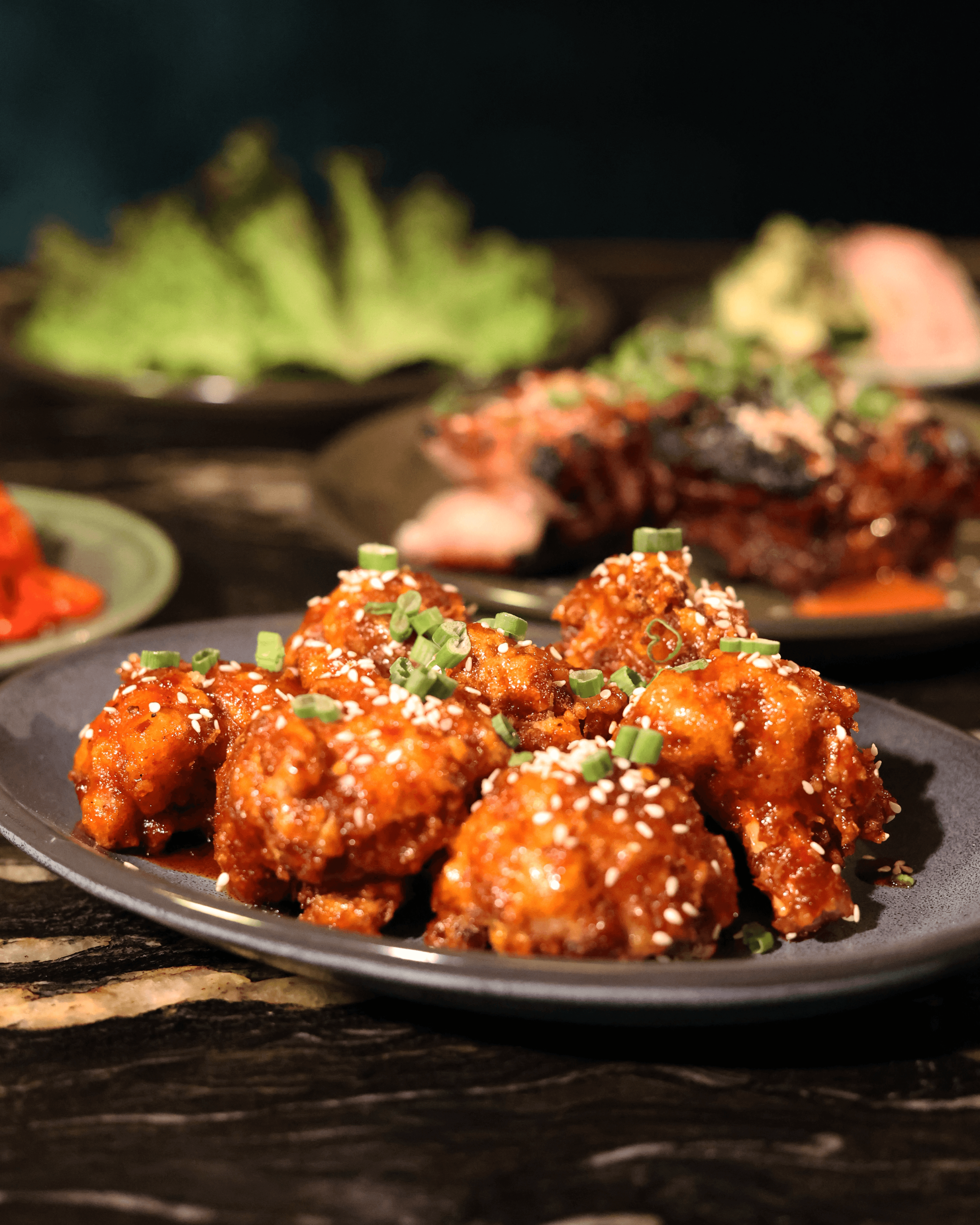

Korean Fried Cauliflower at Callisto — The Best Vegetarian Bar Bite in Downtown Bentonville
A cocktail bar vegetarian option usually falls into one of two categories: a sad afterthought for the person at the table who doesn't eat meat, or something so hedged and cautious it barely registers as food. Callisto's Korean Fried Cauliflower is emphatically neither. Tempura-battered cauliflower, glazed in a gochujang-based KFC sauce, finished with sesame and scallions — this is a plate that people order regardless of dietary preference, and reorder because it's genuinely good.
Here's what to know before you visit.
What Is Korean Fried Cauliflower and Why Is It on a Cocktail Bar Menu?
The dish draws directly from the tradition of Korean yangnyeom chicken — fried chicken seasoned with a sweet and spicy sauce built on gochujang, garlic, and sugar, a style so canonically Korean that The New York Times called it "the apotheosis of the Korean style" of fried chicken. The concept of Korean fried food as specifically drinking food has roots going back decades — fried chicken paired with beer became so culturally embedded in South Korea that it spawned its own term, chimaek (치맥), combining the words for chicken and beer.
Callisto's version replaces the chicken with tempura-battered cauliflower, applying the same yangnyeom-style glaze to a vegetarian base. It's a substitution that works because the delivery mechanism — the crispy battered exterior, the sticky sweet-heat glaze — doesn't actually depend on the protein underneath. What makes Korean fried food compelling is the crunch-to-sauce ratio and the layered flavor profile of the glaze. Cauliflower, batted correctly, delivers both.
The dish belongs on a cocktail bar menu for the same reason yangnyeom chicken belongs with beer: it is, by long tradition, food meant to be eaten while drinking.
What Does the KFC Sauce Actually Taste Like?
KFC here stands for Korean Fried Cauliflower — but the sauce has a defined identity worth understanding before you order.
Gochujang, the fermented chili paste at the core of most Korean fried sauces, was first documented between the 16th and 17th century and has since become one of the staple condiments of Korean cuisine. It carries a smoky-sweet and slightly spicy flavor — some brands run hotter than others, but its defining quality is heat, richness, tang, and a little sweetness working together rather than any single note dominating.
The yangnyeom sauce at its best creates a glaze that's sticky, glossy, and complex — sweet upfront, building to heat, finishing with the fermented depth that distinguishes gochujang from a simpler chili sauce. Combined with the tempura batter's crunch, the glaze coats each piece of cauliflower without drowning it — you're getting a generous layer that clings, not a pool that turns the batter soggy immediately.
The result lands somewhere that most people struggle to articulate on the first bite: sweet, spicy, savory, and slightly fermented, in proportions that keep you reaching back for another piece.
Why Does the Tempura Batter Matter Here?
This is worth understanding, because the batter is doing significant structural work in the dish.
Tempura batter — made with iced water, eggs, and soft wheat flour, mixed minimally — derives its characteristic lightness from deliberately limited gluten development. The cold temperature slows gluten formation, and the intentional undermixing (lumps are acceptable, even desirable) produces a thin, airy coating rather than a dense crust. Cold batter mixed at low temperatures reacts better with hot oil, resulting in a puffier, lighter finished product.
For a dish glazed in sticky sauce, this matters considerably. A heavy batter absorbs the glaze and goes soft within minutes. Korean fried chicken's signature characteristic — the thin, crackly, almost transparent crust described by Julia Moskin of The New York Times — is precisely what allows it to hold up under sauce. Tempura achieves a similar outcome for different reasons, maintaining enough structural integrity that the cauliflower stays crispy through the glazing process.
The practical upshot: the Korean Fried Cauliflower at Callisto doesn't degrade quickly. You can carry a full conversation, order a second round, and the texture holds well enough to reward the table's attention at its own pace.
Is This a Good Option If I'm Not Vegetarian?
Straightforwardly yes. The dish doesn't position itself as a vegetarian alternative to something else on the menu — it stands on its own terms, and the flavor profile doesn't require any context around dietary preference to land well.
The KFC sauce is the draw, not the absence of meat. If you've eaten yangnyeom chicken before and liked it, the logic of the dish will be immediately familiar. If you haven't, the Korean Fried Cauliflower at Callisto is a reasonable first introduction to that flavor profile — the cauliflower provides a mild, neutral base that lets the sauce speak clearly.
For tables with mixed dietary preferences, this plate sidesteps the problem of ordering something that only works for part of the group. It orders easily, shares easily, and disappears regardless of who's eating what else.
How Spicy Is the Korean Fried Cauliflower?
Moderately, with some nuance worth knowing. Gochujang-based sauces build heat gradually rather than delivering it upfront — the first bite usually registers sweet before it registers spicy, and the heat comes in on the finish. Gochujang's heat varies by brand, but its defining quality is that it works in combination with sweetness and fermented depth rather than as a standalone source of fire.
The practical experience at Callisto is a sauce with genuine warmth that accumulates across the plate — not a one-bite moment of intensity, but a sustained low heat that pairs well with cocktails precisely because it keeps the palate engaged without punishing it. For guests with low heat tolerance, it's worth mentioning to your server. For everyone else, the spice level is well within the range most people consider enjoyable rather than challenging.
Sesame and scallions finish the dish, providing nuttiness and brightness that temper the heat from the glaze and add textural contrast to the glazed batter.
What Should I Drink with Korean Fried Cauliflower at Callisto?
The Korean tradition of pairing fried food with beer — chimaek — reflects an intuition that carbonation and mild bitterness cut through fat and reset the palate between bites. Callisto doesn't run a beer-forward program, but the principle applies to cocktails with similar characteristics: carbonation, acidity, or bitter-adjacent elements.
A rum-forward tiki cocktail with citrus and fresh juice will do the palate-cleansing work that beer does in the original Korean context. Something with pineapple or passionfruit will complement the sweetness of the gochujang glaze. Avoid cocktails heavy on dessert sweetness or cream — they'll clash with the fermented depth of the sauce.
If you're ordering this plate alongside the Shishito Peppers or the Hurricane Popcorn, any cocktail you'd pair with either of those will work here too. The three plates together cover enough different flavor registers that the drink pairing becomes about personal preference rather than necessity.
When Should I Order the Korean Fried Cauliflower During the Night?
It works across most of the evening, but sits best in the early-to-mid section of the night. Order it with the first round — it arrives quickly, it's easy to share while the table gets settled, and the glaze holds well enough that it doesn't need to be eaten the instant it lands.
Mid-night, as drinks have stacked up and the table has found its rhythm, it's a reliable reorder. The warmth from the gochujang sits well alongside spirit-forward cocktails. Late in the evening it can feel slightly heavy if the table has already moved through several other plates, but as a standalone order at any point in the night, it rarely disappoints.
One honest note: the tempura stays crispier earlier in its life. Like all fried food, it's best in the first fifteen minutes. Order it when the table is ready to eat it, not as a placeholder for later.
How Does the Korean Fried Cauliflower Compare to Other Plates at Callisto?
Within Callisto's food menu, the Korean Fried Cauliflower occupies the middle register between the lighter openers and the more substantial plates. It's more filling than the Shishito Peppers or the Hurricane Popcorn, less so than the Potato Croquettes or the Manapua Pork Belly Buns.
For a table building a spread, it pairs naturally with the Cream Cheese Rangoons — both are fried, both are sauced, but they operate in entirely different flavor registers. The rangoons are rich and creamy with sweet chili; the cauliflower is sticky-spicy with fermented depth. Together they give the table contrast without redundancy.
For a two-person table planning a longer evening, the cauliflower and the Yellowfin Tuna Poke alongside one or two cocktails is a well-structured combination: one plate light and fresh, one warm and substantial, both easy to share.
Is Callisto Worth Visiting for Vegetarian Food in Bentonville?
Northwest Arkansas's dining scene has expanded considerably over the past several years — Crystal Bridges and the broader arts-and-outdoor-recreation draw have brought with them a food culture more interested in quality and variety than the region's reputation might once have suggested. Callisto sits near the center of that shift.
For vegetarian visitors, the Korean Fried Cauliflower is the strongest argument for Callisto specifically. It's the kind of plate that doesn't require any adjustment of expectations — it's designed to be this good, and it is. Executive Chef Alex Siharath built a menu where vegetarian options aren't concessions but actual dishes with culinary logic behind them.
The cocktail program — built by owners Braxton and Izaak Barrett around rum, tiki tradition, house-made syrups, and fresh juice — pairs naturally with the food regardless of dietary preference. Accessing all of it requires finding the concealed entrance inside the Midnight Gallery at 407 SW A St, which is part of the experience. Reservations are recommended, particularly Thursday through Saturday.
Why the Korean Fried Cauliflower Earns a Spot in the Rotation
There are very few dishes at a cocktail bar that work equally well as a first plate, a mid-night order, a solo snack, or as part of a larger spread for a celebration table. The Korean Fried Cauliflower at Callisto manages all of those scenarios without feeling like it's compromising on any of them.
Yangnyeom-style fried food has been considered anju — food specifically eaten while drinking — in South Korea for decades. Callisto's Korean Fried Cauliflower carries that tradition forward in a form that happens to be vegetarian, happens to be deeply delicious, and happens to fit a tropical speakeasy in Bentonville as naturally as it would fit a fried chicken shop in Seoul.
Order it. It'll be gone before you think to slow down.
Callisto Cocktail Bar 407 SW A St, Bentonville, AR 72712 Tuesday–Thursday 4pm–11pm | Friday–Saturday 4pm–1am | Sunday 4pm–11pm Reservations: callisto.bar