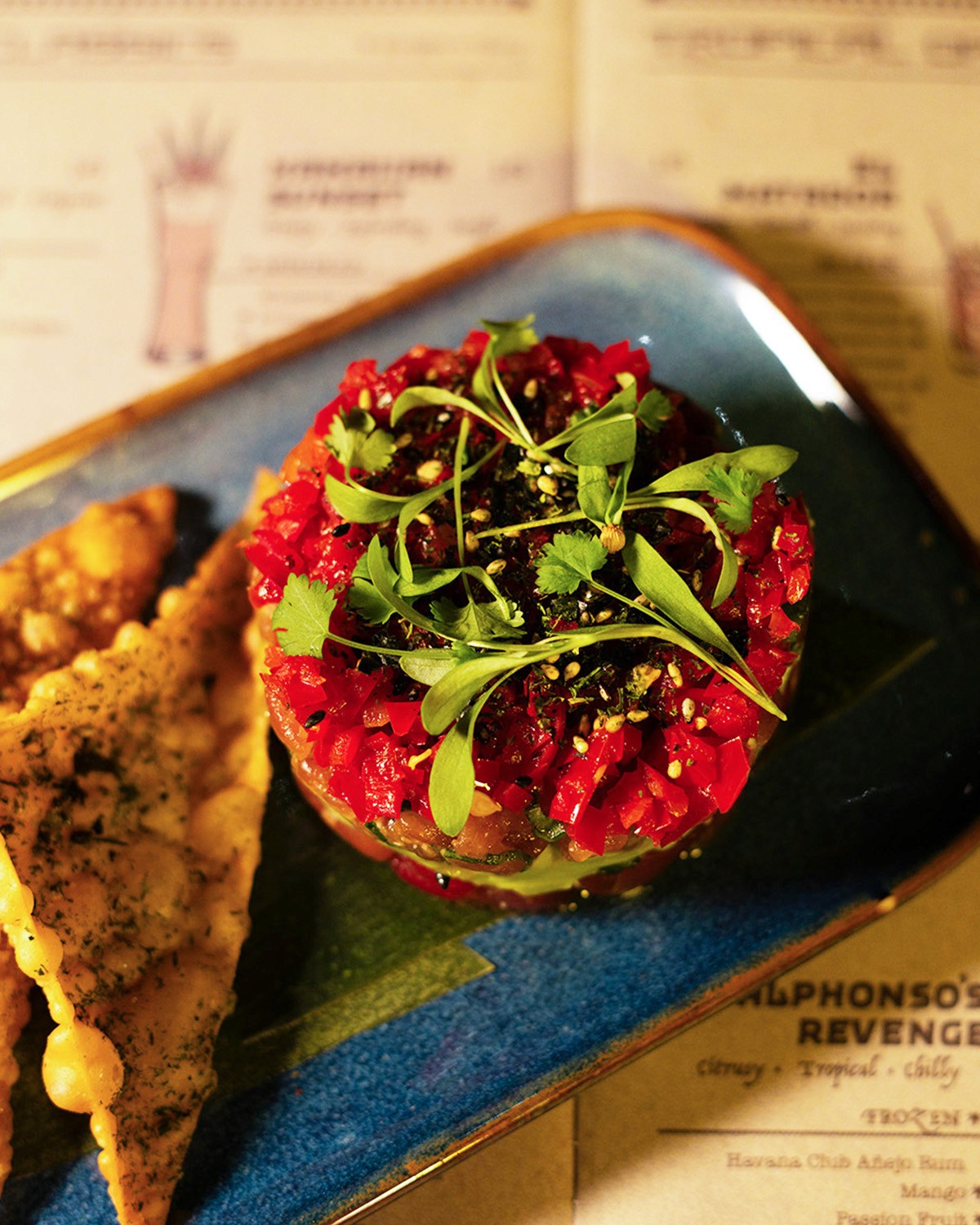

Yellowfin Tuna Poke at Callisto — The Freshest Plate in Downtown Bentonville
A cocktail bar committing to raw fish is a statement of confidence. Most bars avoid anything that requires this level of sourcing attention and kitchen precision. Callisto's Yellowfin Tuna Poke earns that confidence — sashimi-grade ahi tuna dressed in a tamari vinaigrette, layered with avocado mousse, wasabi micro greens, and furikake, served with wonton chips for crunch. It's the lightest plate on the menu and, for the right table, the most memorable one.
Here's everything worth knowing before you order.
What Is Poke and Where Does It Come From?
The word poke (pronounced poh-kay) comes from Hawaiian and means, literally, to cut into cubes — which is exactly how the fish is prepared in its traditional form: cubed raw fish with sea salt. The dish traces back to reef fishermen cutting off bits of raw fish for a snack, sometimes rubbing them in sea salt — a tradition thought to stretch back roughly 1,500 years on the Hawaiian Islands.
The version most people recognize today arrived through layers of cultural influence. In the 1970s and 1980s, as Asian immigrants settled in Hawaii, Japanese and other Asian culinary traditions combined with native Hawaiian fish preparation — leading to the incorporation of soy sauce, seaweed, and sesame oil into what had been a much simpler dish. In dining restaurants, poke is often served tartare-style or with fried wonton chips, sometimes called poke nachos. Callisto's version sits squarely in that more refined, restaurant-format lineage — yellowfin tuna treated carefully and presented with enough compositional thought that it belongs on the same table as the bar's most technically accomplished cocktails.
Yellowfin tuna became the dominant poke fish when deep-sea fishing made it commercially available in the 1960s; chefs now generally use sushi-quality yellowfin as the standard. Callisto uses sashimi-grade fish — the quality tier required for safe raw consumption and the threshold above which the flavor of the tuna itself actually matters.
What Does Yellowfin Tuna Taste Like?
This is the question worth answering before deciding whether this plate is for you. Yellowfin tuna has a mild, meaty flavor, often compared to swordfish — more flavorful than albacore but leaner than bluefin, with bright red flesh that signals freshness and fat content. Chefs describe its flavor as medium-mild with a very firm texture.
What that means in practice: the fish is substantial enough to hold up to dressing and toppings without getting lost, but clean enough that anything applied to it registers clearly. The tamari vinaigrette at Callisto does deliberate work here. Tamari is a Japanese form of soy sauce — traditionally a byproduct of miso production — made with a higher ratio of soybeans and little to no wheat, resulting in a richer, thicker texture and a deeper umami flavor with less of the sharp saltiness of conventional soy sauce. Where soy sauce cuts, tamari coats — building umami that feels smooth and rounded rather than sharp and immediate.
Against a clean, mild fish like yellowfin, that distinction matters. A standard soy-based dressing would compete with the tuna. The tamari vinaigrette deepens it.
What's Actually in Callisto's Yellowfin Tuna Poke?
The dish is composed in layers, and each component has a specific job.
The sashimi-grade yellowfin tuna arrives cubed and dressed in the tamari vinaigrette — enough to coat and season the fish without the marinade becoming the main event. Avocado mousse sits alongside or beneath, adding a luxurious creaminess that provides textural contrast to the lean, firm tuna. Where the fish is clean and direct, the avocado is lush and neutral — the two work together the way they always do, which is to say reliably and well.
Wasabi micro greens introduce a sharp, lingering heat that builds differently from chili heat — more sinus-clearing and herbal, dissipating quickly and leaving the palate refreshed rather than lingered-on. Furikake threads through the whole plate: the Japanese condiment of sesame, seaweed, sugar, and salt adds oceanic umami as a finishing note while tying the dish back to the Hawaiian-Japanese fusion tradition poke has always represented.
Wonton chips provide the crunch — light and neutral enough not to distract from the tuna, sturdy enough to scoop without disintegrating. The format quietly recalls the poke nacho tradition without committing to it fully. You can eat the components separately or use the chips as a vehicle. Both approaches work.
Is the Poke a Good Choice If I Don't Normally Order Raw Fish?
Probably yes, with a few caveats worth knowing.
Sashimi-grade yellowfin is among the most approachable raw fish available — its flavor is mild rather than aggressive, its texture is firm rather than gelatinous, and the tamari vinaigrette and avocado mousse provide familiar, comfortable anchors for anyone who isn't accustomed to eating fish raw. Yellowfin tuna's combination of mild flavor and meaty texture makes it ideal for raw preparations for exactly this reason.
If your hesitation around raw fish is textural, the wonton chips help — eating the tuna on a chip changes the experience considerably, adding crunch and giving the bite a more composed, structured feel. If it's about flavor intensity, the avocado mousse softens that too.
The one scenario where this plate probably isn't the right call: if you have an actual aversion to the taste of raw fish rather than unfamiliarity with it. The tamari and avocado can moderate the experience, but they can't fully transform it. For that table member, the Potato Croquettes or the Cream Cheese Rangoons are the more comfortable choice.
Is the Poke Good for Sharing, or Is It More of an Individual Order?
It's built for sharing, though it shares differently than the Hurricane Popcorn or the Shishito Peppers. Those plates are grab-and-go by design. The poke is more composed — it rewards a moment of attention, a considered bite with the right combination of components, rather than being reached into between sentences.
For a table of two, one plate is a generous first course. For a larger group, it works best ordered alongside something more immediately snackable — the Hurricane Popcorn or Shishito Peppers give the table something to eat casually while the poke gets the attention it merits. Together, the three plates cover every register: light and fresh, warm and savory, bright and charred. That's a well-constructed first round.
What Should I Drink with Yellowfin Tuna Poke at Callisto?
The tamari vinaigrette provides the most useful pairing signal. Because tamari delivers deep umami with a smooth, rounded finish rather than sharp salt, it pairs well with cocktails that have complementary sweetness or bright acidity. The avocado mousse adds richness that calls for something to cut through it. The wasabi micro greens want something cooling.
Callisto's tiki-forward cocktail program — rum, fresh citrus, house-made syrups — hits several of those targets simultaneously. A drink built on rum and fresh lime will cut through the avocado's fat and complement the tamari's umami. Something with pineapple or passionfruit will echo the tropical context poke already carries. Avoid anything particularly sweet or dessert-forward early in the evening alongside this plate — the delicacy of the tuna gets overwhelmed rather than complemented.
If you're uncertain, tell your server what you're ordering for food. The bar team at Callisto understands the menu well enough to make a useful recommendation.
Is the Poke a Good Date Night Order at Callisto?
It's an excellent one, specifically because of what it signals about the evening. Ordering raw fish at a cocktail bar is a vote of confidence in the kitchen — and in the night itself. It says the table is settling in, paying attention, and not just ordering the obvious things.
The format also supports a date well. It's shareable without being communal in a way that creates pressure. You can eat your own portion or pass the wonton chips back and forth. The components are visually interesting enough to spark a moment of conversation — what's in it, what that ingredient is, whether the wasabi micro greens actually deliver — without the plate demanding to be talked about.
Paired with date night cocktails from Callisto's program, the poke creates a particular opening-of-the-evening rhythm: something fresh and light to start, followed by something richer if the table stays for more plates, carried along by drinks that keep evolving. That's the architecture of a good night rather than just a good meal.
When Is the Right Time to Order the Poke During the Night?
Early, without question. The cold temperature, clean flavors, and light profile of the poke make it a natural first plate — something the palate can appreciate fully before it's encountered multiple cocktails and heavier food. Mid-evening it still works as a palate reset, particularly if the table has moved through the Potato Croquettes or the Pork Belly Buns and wants something to pull the evening back toward brightness and freshness.
Later in the night, the poke loses some of its impact — not because it changes, but because the palate does. After several rounds of spirit-forward drinks, the subtlety of sashimi-grade tuna dressed in tamari is harder to appreciate fully. Order it when you can give it the attention it deserves.
Is Callisto Worth Visiting for Food in Downtown Bentonville?
The cocktail program is the draw that most people arrive for, and it's genuinely accomplished — rum-forward, tiki-adjacent, built on fresh juice and house-made syrups that reflect real craft. The food menu, built by Executive Chef Alex Siharath, was designed to support that program rather than exist independently of it. Everything is calibrated for the rhythm of a cocktail-first evening: shareable, sequenced, not so heavy that it interrupts the drinking.
The Yellowfin Tuna Poke sits at the lighter end of that menu and represents its most technically demanding preparation. Getting raw fish right in a cocktail bar environment — sourcing properly, preparing carefully, serving at the right temperature — takes commitment that most bar kitchens don't bother with. Callisto bothers.
For visitors to Bentonville coming through for Crystal Bridges, the Razorback Greenway, or a night on the Bentonville square, Callisto tends to be the recommendation that sticks. The poke is part of why.
Reservations are strongly recommended, particularly Thursday through Saturday. The bar is accessed through a concealed entrance inside the Midnight Gallery at 407 SW A St — a detail worth knowing before you arrive, not after.
Why the Yellowfin Tuna Poke Earns Its Place on Every Visit
There's a version of a cocktail bar food menu where everything is fried, everything is heavy, and the food exists primarily to slow alcohol absorption. Callisto's menu doesn't operate that way, and the Yellowfin Tuna Poke is the clearest evidence of it.
Poke has been evolving for over a thousand years — from Hawaiian fishermen's snacks to a globally recognized dish shaped by Japanese, Pacific, and American culinary traditions. Callisto's version honors that lineage with sashimi-grade fish, a thoughtfully constructed dressing, and components that each contribute something the dish would miss without them. It's the kind of plate that makes the whole menu feel more considered.
Order it early, pair it well, and give it the moment it earns.
Callisto Cocktail Bar 407 SW A St, Bentonville, AR 72712 Tuesday–Thursday 4pm–11pm | Friday–Saturday 4pm–1am | Sunday 4pm–11pm Reservations: callisto.bar